
Introduction
In the global ceiling fan industry, the debate between AC (Alternating Current) and DC (Direct Current) motors has shifted from a technical novelty to a critical business decision. For bulk buyers, developers, and wholesalers, choosing the wrong motor technology can lead to high maintenance costs or missed market opportunities.
The main difference between AC and DC ceiling fans is the motor type: AC (Alternating Current) motors use traditional wall power and are cheaper, while DC (Direct Current) motors use internal transformers for higher energy efficiency (up to 70% savings), quieter operation, and smart control, making them the preferred choice for modern wholesale buyers.
As a dedicated ceiling fan manufacturer, we have seen the evolution of both technologies on our production lines. In this guide, we will strip away the marketing fluff and provide a data-driven comparison to help you optimize your next wholesale order.
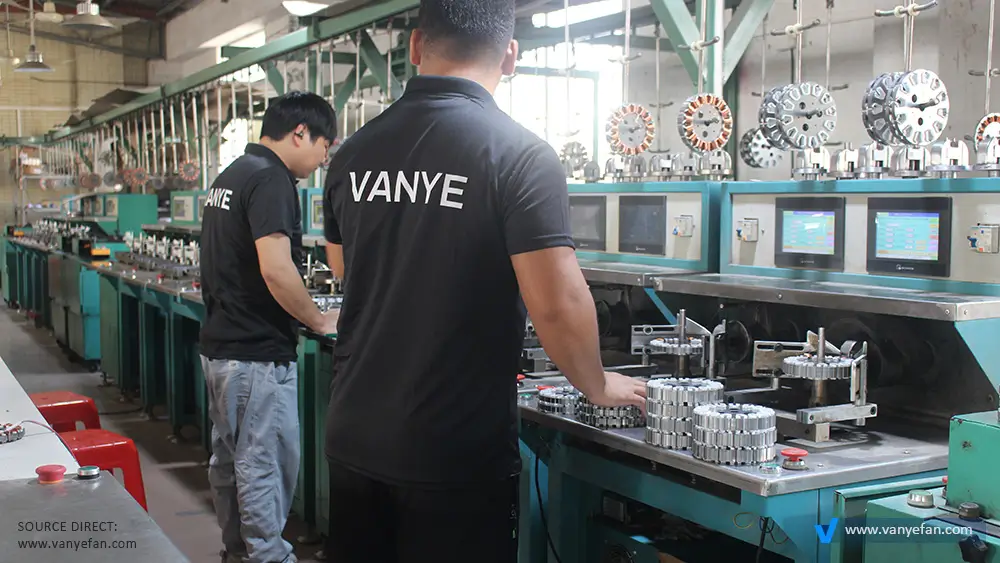
Inside our state-of-the-art facility: Our skilled technicians monitoring the automated motor winding and assembly process to ensure 100% reliability.
Understanding the Core Technologies (AC vs. DC)
1. The Core Difference: Performance vs. Simplicity
The fundamental difference lies in how the motor consumes electricity. AC motors connect directly to your power source, while DC motors use an internal transformer and a PCB driver to convert power.
- AC Motors: The "Workhorse." They are incredibly rugged and simple. However, they are limited to 3 or 4 speeds and tend to generate more internal friction and heat.
- DC Motors: The "Precision Instrument." They use permanent magnets, which eliminates the electrical friction found in AC motors. This allows for up to 6 speeds and near-silent operation.
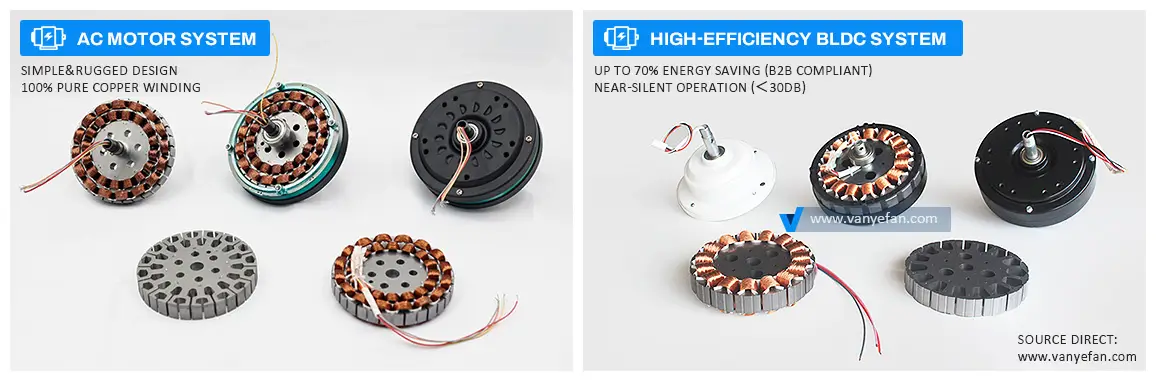
Direct Factory Comparison: Inside the VANYE Lab: A detailed look at the internal architecture of our AC and BLDC motors. Whether you prioritize the cost-effectiveness of AC or the silent, eco-friendly performance of DC, our 100% copper-wire motors are engineered for industrial-grade durability and 10+ years of service life. [View our full DC Motor Fan Catalog]
| Comparison Dimension | Traditional AC Motor (Old-style Ceiling Fan Lights) | BLDC Brushless DC Motor |
|---|---|---|
| Core Principle | AC induction motor (shaded-pole or capacitor-run type). The rotor is driven by electromagnetic induction from the stator’s alternating magnetic field, with no permanent magnets. | Brushless DC motor. The stator generates a magnetic field when powered, driving the outer rotor with built-in permanent magnets to rotate. Requires an electronic controller. |
| Drive Method | Directly connected to 220V AC power, with speed controlled by a capacitor or tap windings. | Converts 220V AC to DC first, then precisely controls current and speed via a driver board. |
| Noise Performance | Typically 35-50dB, with noticeable electromagnetic hum at low speeds. Noise tends to worsen over time. | Typically 20-30dB. Almost silent at low speeds, with no brush friction noise. |
| Energy Efficiency | Low efficiency (approx. 30%-50%). 60-100W power for the same specification, with most energy converted to heat. | High efficiency (approx. 70%-90%). Only 15-35W power for the same specification, saving over 50% energy with minimal heat generation. |
| Speed Control Experience | 3-6 fixed tap gears with large jumps in wind speed; no stepless adjustment available. | 6+ gears or stepless speed control. Soft, natural airflow, with modes like sleep wind and natural wind available. |
| Lifespan & Maintenance | Prone to bearing wear and winding aging. Noise increases significantly after 3-5 years. No brushes but high mechanical wear. | No brush wear. Uniform stress on bearings, with minimal noise change after 10+ years of use. Low maintenance cost. |
| Size & Installation | Larger and heavier for the same power, requiring a heavy mounting base. | Thinner and lighter for the same power, with lower installation stress. Ideal for modern slim ceiling fan light designs. |
| Cost & Process | Simple structure with low-cost controllers, hence low overall cost. | Requires permanent magnets and driver boards, with high winding process requirements. |

Our integrated manufacturing chain: (Left) 100% pure copper winding; (Center) Automated precision control; (Right) Final silent operation testing in our decibel-controlled chamber.
Understanding the Core Technologies (AC vs. DC)
2. Speed Control Logic: Night-and-Day Difference in Airflow Experience
- AC Motors: Speed is controlled by changing the number of turns in the stator windings (tap control), which only provides 3-5 fixed gears. Wind speed jumps suddenly when switching gears (e.g., from Gear 1 to Gear 2), and the magnetic field becomes unstable at low speeds, leading to even louder noise.
- BLDC Motors: The driver board precisely controls the current magnitude and frequency, enabling stepless speed control (continuous adjustment from 1% to 100% speed). This results in extremely soft airflow, with natural wind or sleep wind modes (variable speed) available. It’s almost silent at low speeds, so it won’t disturb your sleep at night.
3. Efficiency Standards: Why DC is Winning the Global Tender
In 2026, energy efficiency isn't just about saving money; it’s about compliance. Many government projects in Europe and North America now require minimum CFM/Watt (Cubic Feet per Minute per Watt) ratings that only DC motors can consistently meet.
- Energy Consumption: A typical DC motor uses 60-70% less energy than an AC motor to move the same volume of air.
- Carbon Credits: For large-scale real estate developments, utilizing DC motor fans can contribute significantly to green building certifications (like LEED).
4. The "Silent" Factor in Luxury Hospitality
If you are sourcing for hotels or high-end residential projects, noise level is a deal-breaker.
- AC Hum: AC motors often produce a low-frequency hum, especially when dimmed.
- DC Silence: Because DC motors are digitally controlled, they are virtually silent. At VANYE, our DC models consistently test below 30dB, making them the preferred choice for bedrooms and quiet commercial spaces.
Manufacturing Reliability and Cost Analysis
5. Reliability and the "Driver" Myth
One common concern among wholesalers is: "Is the DC motor PCB driver a point of failure?" It is true that AC motors are simpler and can last decades. However, the reliability of a DC fan depends entirely on the quality of the capacitor and the driver design. * Our Manufacturing Standard: We use high-voltage resistant capacitors in our DC drivers to handle the power surges common in markets like Southeast Asia and Africa. This has reduced our wholesale defect rate to less than 0.3%.
6. Summary Table for Professional Buyers
| Feature | AC Motor Fans | DC Motor Fans |
|---|---|---|
| Ideal For | Budget-conscious retail / Industrial | Premium Residential / Luxury Hotels |
| Wholesale Cost | Lower Initial Investment | Higher (Balanced by Energy Savings) |
| Control Features | Basic (Wall control / Pull chain) | Advanced (Remote / App / 6-Speeds) |
| Airflow Direction | Manual Switch | Remote Controlled Reverse |
Conclusion: Which Should You Order?
The choice depends on your target market's "Pain Points":
- Choose AC if your primary competitive advantage is price point and your customers prefer traditional, heavy-duty simplicity.
- Choose DC if you are building a premium brand, targeting smart-home enthusiasts, or bidding for projects where energy efficiency is a legal requirement.
A: Yes. Although DC fans have a slightly higher initial cost, their 70% energy savings, longer lifespan (10+ years), and higher retail profit margins make them more profitable for wholesalers and brands.
A: Absolutely. DC motors are inherently compatible with smart drivers, making them the standard for Tuya/WiFi enabled smart ceiling fans.
Final Call to Action (CTA)
As a professional ceiling fan manufacturer, VANYE offers both high-efficiency DC models and reliable AC classics.
Ready to Upgrade Your Ceiling Fan Product Line?
Partner with VANYE. Enjoy Low MOQ (50 PCS), 10-Year Motor Warranty, and 25-35 Days Fast Delivery.
Email us: info@vanyefan.com
|
️ Guaranteed reply within 12 hours