
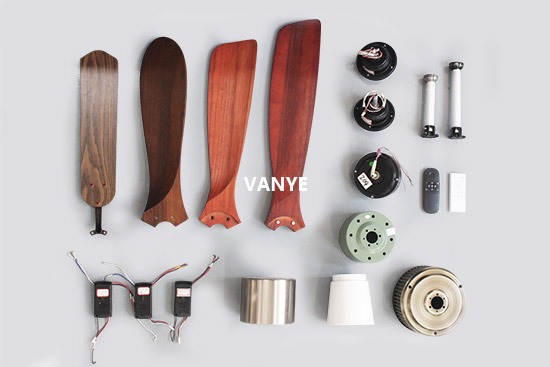
Introduction
If you are wondering how to choose the modern ceiling fan for wholesale or large-scale developments, you need to look beyond the surface.
Most online guides tell you to pick a fan that "looks good." But as a manufacturer who has seen thousands of fans come off the assembly line, I can tell you: A beautiful fan that clicks, wobbles, or fails to move air is just an expensive ceiling ornament. When it comes to bulk ceiling fan sourcing for high-end projects, understanding the technical core of modern DC motor ceiling fans is vital. In 2026, a "modern" fan is defined by more than just slim lines—it’s about the integration of BLDC technology, airflow physics, and smart aesthetics.
Beyond Aesthetics: The Anatomy of a Modern Fan
1. The Motor is the Soul (Why DC is Non-Negotiable)
If you are buying for a modern project, forget AC motors. They are bulky and limit design possibilities. As a leading ceiling fan manufacturer in China, we have optimized our 120mm to 155mm high-efficiency BLDC motors to allow for the "ultra-slim" canopy design that architects crave.
- The "Modern" Standard: Look for 120mm to 155mm high-efficiency BLDC motors. They allow for the "ultra-slim" canopy design that architects crave.
- Inside Tip: Ask your supplier about the pure copper winding density. A lighter motor often means aluminum-core wiring, which will overheat and hum within 12 months.
2. Blade Material: ABS vs. Wood vs. Plywood vs. Metal
- ABS (Aerodynamic Precision): Currently the "Gold Standard" for modern fans. Unlike traditional materials, ABS can be molded into complex, organic airfoil shapes (similar to airplane wings). This creates higher CFM (Cubic Feet per Minute) with significantly less wind noise. [Browse our ABS Blade Modern Fan Collection]
Best for: Coastal projects and high-humidity areas, as it never warps or rusts. - Solid Wood : The premium choice for "Modern Organic" aesthetics. Hand-carved solid wood blades offer a unique grain that synthetic materials can't replicate. [Browse our Solid Wood Blade Modern Fan Collection]
Warning: Solid wood is heavy. It requires a high-torque DC motor (at least 155mm or 188mm) to start smoothly without straining the bearings. - Plywood (The Cost-Effective Classic): Often used in entry-level modern fans. It consists of multiple layers of wood compressed together. While lightweight, it is susceptible to moisture. [Browse our Plywood Blade Modern Fan Collection]
Expert Insight: In B2B sourcing, ensure the plywood has a balanced finish on both sides. If one side is poorly sealed, the blades will sag over time, causing the fan to wobble. - Metal (Iron, Aluminum or Steel): Traditionally found in industrial settings, but now trending in "Industrial Modern" lofts. Metal blades are incredibly durable and can move massive amounts of air. [Browse our Metal Blade Modern Fan Collection]
The Trade-off: Metal blades are dangerous at low mounting heights and are much louder due to air shearing. We only recommend metal blades for ceilings higher than 3 meters (10ft).
[Factory Comparison Tip]: If your project is a luxury hotel near the ocean, ABS is your only safe bet. If it’s a high-end dry-climate villa, Solid Wood provides the ROI in terms of luxury feel.
Strategic OEM Services: Beyond Standard Manufacturing
For wholesalers, brand owners, and developers, a modern ceiling fan isn’t just a product—it’s a representation of your brand. Choosing a partner that offers comprehensive OEM services is critical to your market success.
Complete Customization Capability
At VANYE, we don't just put your logo on a box. We provide a full-spectrum OEM solution designed for the 2026 market:
- Aesthetic Customization: From exclusive blade finishes (wood grain, matte textures) to bespoke motor housing designs that align with your brand’s identity.
- Technical Modification: Need a specific RPM range, a custom remote control interface, or a specialized PCB driver for unstable power grids? Our engineering team can modify the internal specs to meet your local market demands.
- Sustainable Packaging: We offer eco-friendly, high-strength retail packaging that passes international drop tests, ensuring your brand arrives in perfect condition.
Why Partner with VANYE for Your Private Label?
As a specialized ceiling fan manufacturer in China, we understand the pain points of bulk ceiling fan sourcing. Our factory is equipped to handle:
- Low Defect Rates: Our 100% motor testing protocol ensures your after-sales costs remain low.
- Supply Chain Transparency: You get direct access to our production timelines, ensuring your seasonal launches are never delayed.
Sourcing Insight: In the modern ceiling fan market, speed-to-market is everything. When choosing an OEM factory, look for a partner with integrated R&D. Our ability to move from a design concept to a certified prototype in record time is what keeps our global partners ahead of the seasonal demand.
Sizing, Airflow, and Sustainability Standards
In 2026, BLDC ceiling fan energy efficiency isn't just a "plus"—it is a legal requirement for most international government tenders. Beyond the electricity savings, the precision of a DC motor allows for a wider range of sizes without sacrificing performance.
Engineering Quality Control: Reality vs. Marketing Myths
Before committing to a high-volume B2B order, you need to understand the technical realities of noise and balance. Don't be misled by "lab-only" data.
1. The Balance Truth: Why "Balancing Clips" Aren't Always Bad
In the industry, there's a common misconception that premium fans shouldn't need balancing clips. The reality is different.
- Dynamic Balancing at Factory: At VANYE, we dynamically balance every motor and blade set during production. However, because modern blades (especially solid wood or plywood) have natural density variations, a minor adjustment clip is a sign of a meticulous QC process, not a defect.
- The "Wobble" Source: A fan that wobbles usually isn't just "unbalanced"—it's often due to inconsistent blade weight or a misaligned downrod. For bulk orders, we ensure every blade in a set is weighed within a 1-gram tolerance to minimize the need for site adjustments.
2. Decibel Realities: Motor Silence vs. Aerodynamic Wind Noise
Don't let suppliers fool you with "20dB" marketing stickers. To a professional buyer, you must distinguish between Mechanical Noise and Airflow Noise.
- The Motor (Silent): Our DC motors, when tested in a soundproof chamber without blades, consistently run under 25-30dB. This is the "silent" mechanical performance we guarantee.
- The Blades (The Physics of Wind): Once you attach blades and move air, physics takes over.
At Low Speed: A well-engineered fan can operate around 32-35dB, which is excellent for a sleeping environment.
At High Speed: Wind shear (the sound of blades cutting through air) will inevitably reach 45-55dB. - Insider Advice: If a supplier promises "Silence" at 200 RPM, they are lying. Your goal shouldn't be "total silence" at high speed, but the elimination of motor humming and clicking.
Frequently Asked Questions (FAQ)
Q: What is the most energy-efficient motor for modern fans?
A: BLDC motors are the industry standard for 2026, consuming up to 70% less energy than traditional AC motors.
Q: Are 3-blade fans better than 5-blade fans?
A: For modern aesthetics, 3-blade fans are popular. Technically, fewer blades create less drag, allowing for higher speeds and airflow, while more blades tend to be quieter and move air more softly.